When Should a Beech Tree Be Reduced or Removed?
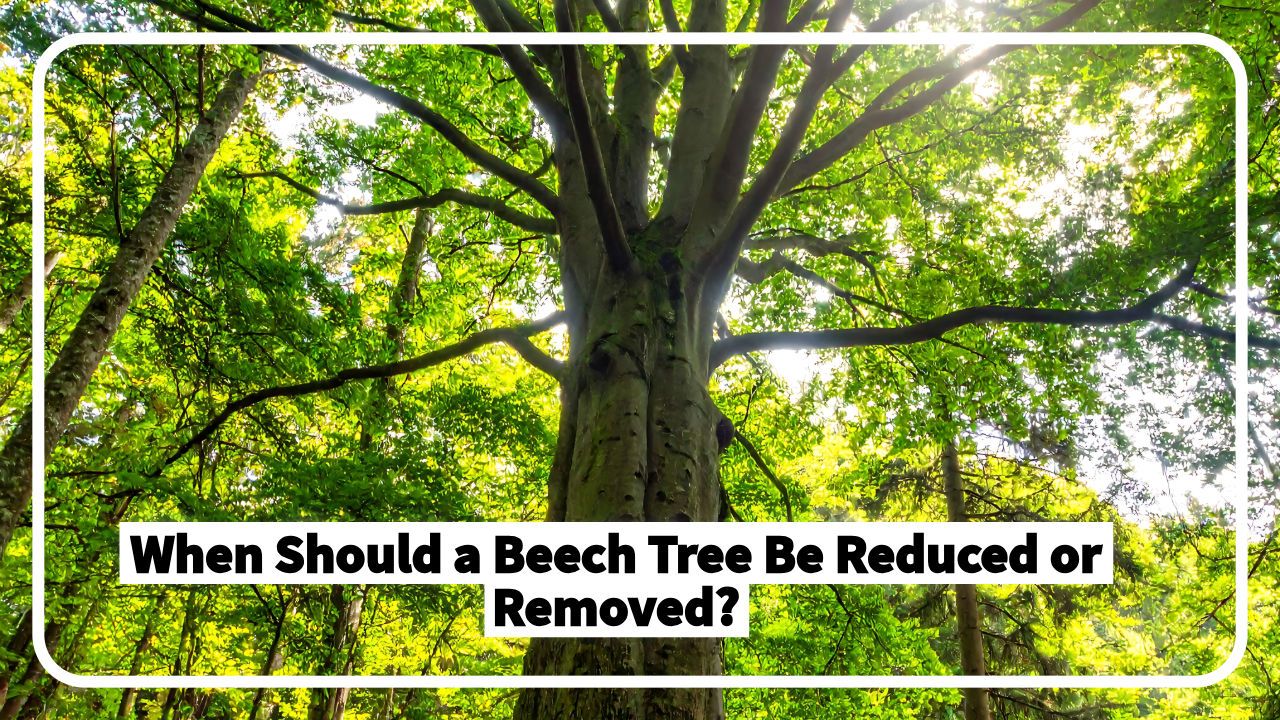
Beech trees are among the most impressive trees found in the UK. Their smooth grey bark, dense canopy and long lifespan make them valuable features in gardens, parks and larger properties.
But a mature Beech can become very large, and its dense canopy can create practical problems in smaller gardens or when the tree is close to buildings and neighbouring properties.
This raises an important question for homeowners:
Should the Beech tree be reduced, or does it need to be removed completely?
The answer depends on the tree’s health, structure, location and the problem you’re trying to solve.
In many cases, careful reduction can manage a problem without removing a healthy tree. Removal is generally considered when the tree cannot reasonably be retained safely or has become unsuitable for its location.
What Does Beech Tree Reduction Mean?
Tree reduction means carefully reducing the overall size of the tree’s canopy.
An arborist may shorten selected branches to reduce:
Overall height
Branch spread
Weight
Clearance problems
The objective is not to simply cut the top off the tree.
A properly planned reduction should maintain the tree’s natural shape and avoid unnecessary stress.
When Should a Beech Tree Be Reduced?
1. The Tree Has Become Too Large for Its Location
A mature Beech can develop a very broad canopy.
If branches are increasingly extending towards:
Your house
Conservatory
Garage
Driveway
Neighbouring property
a professional reduction may help bring the tree back under control.
This can be particularly useful where the tree is healthy but has simply outgrown its available space.
2. The Tree Is Blocking Too Much Light
Beech trees have dense foliage, which can create significant shade.
You may notice:
Your garden receiving very little sunlight
Rooms becoming darker
Other plants struggling to grow
A neighbouring garden losing valuable light
Complete removal isn’t necessarily the answer.
Depending on the tree and its structure, an arborist may recommend a carefully planned reduction or other selective pruning to manage the canopy.
3. Branches Are Growing Too Close to Buildings
Branches that repeatedly touch or overhang a building may need attention.
This is particularly important where branches are:
Rubbing against the roof
Close to windows
Growing over a conservatory
Hanging above a driveway
Selective pruning can often provide the necessary clearance without removing the whole tree.
4. The Canopy Has Become Unbalanced
A Beech can develop uneven growth as it matures.
Signs include:
One side being significantly heavier
Large overextended branches
Crowded areas
Branches crossing or rubbing
A professional can selectively prune the canopy to improve its structure and balance.
5. The Tree Has Dead or Damaged Branches
Deadwood is common in mature trees.
Removing larger dead or damaged branches can:
Reduce the risk of falling limbs
Improve the tree’s appearance
Reduce unnecessary weight
However, extensive deadwood may indicate a wider health issue and should be investigated.
When Should a Beech Tree Be Removed?
Reduction isn’t always appropriate.
Complete removal may need to be considered when the tree has become seriously unsafe or is in irreversible decline.
1. The Tree Is Dead or in Severe Decline
A dead Beech can become increasingly unstable as its wood deteriorates.
Warning signs include:
Extensive deadwood
Large areas of canopy loss
Significant decay
Major bark deterioration
Fungal growth associated with decay
A professional assessment is particularly important for large dead trees close to buildings or public areas.
2. There Is Significant Structural Damage
Removal may become necessary if the tree has major defects such as:
Large trunk splits
Severe cavities
Major cracks
Failed branch unions
Extensive decay
Not every defect means removal is necessary.
An arborist needs to assess the location and severity of the defect and the potential consequences of failure.
3. The Tree Has Been Seriously Damaged by a Storm
Strong winds can cause major damage to mature Beech trees.
After a storm, look for:
Split branches
Hanging limbs
Broken stems
Trunk cracks
Exposed or lifted roots
Sudden leaning
Some storm-damaged trees can be retained through careful pruning.
Others may have suffered damage that makes removal the safer option.
4. The Tree Is Showing Serious Disease or Decay
Beech trees can be affected by various pests and diseases, including Beech Bark Disease, which can damage the bark and potentially contribute to decline.
Other signs that deserve investigation include:
Progressive dieback
Fungal growth
Unusual bark damage
Significant crown decline
Disease doesn’t automatically mean the tree needs to come down.
The important question is whether the condition is affecting its long-term health or structural safety.
5. The Tree Has Become an Unacceptable Safety Risk
A tree’s location matters just as much as its condition.
A large tree with defects above an empty field presents a different risk from one with the same defects beside:
A house
A busy road
A public footpath
A children’s play area
A frequently used driveway
Professional tree risk assessment considers both the likelihood of failure and what could be damaged if failure occurred.
Reduction vs Removal: Which Is Right?
A simple way to think about it is:
Situation | Possible Approach |
|---|---|
Healthy tree is too large | Crown reduction |
Blocking excessive light | Selective reduction/pruning |
Branches touching a building | Targeted pruning |
Dead branches | Deadwood removal |
Unbalanced canopy | Structural pruning/reduction |
Major storm damage | Professional assessment |
Extensive structural decay | Possible removal |
Dead tree | Removal may be necessary |
Severe instability | Removal may be necessary |
This isn’t a substitute for a professional inspection, but it illustrates why removal shouldn’t automatically be the first option.
How Much Can a Beech Tree Be Reduced?
The amount that can safely be removed depends on:
Tree size
Age
Health
Structure
Previous pruning
Species characteristics
Location
Beech trees can respond poorly to excessive pruning.
Aggressive cutting can cause:
Large wounds
Stress
Weak regrowth
An unnatural shape
Increased susceptibility to decay
This is why reduction should be planned rather than approached as simply cutting off a percentage of the tree.
Can You Reduce a Beech Tree Yourself?
Small, straightforward pruning from ground level may be manageable for some homeowners.
However, professional help is strongly recommended when:
The tree is large
Branches are heavy
The tree is close to buildings
Work requires climbing
Branches overhang a road or neighbour’s property
Significant reduction is required
Large branches can weigh hundreds of kilograms and may behave unpredictably when cut.
This isn’t a situation where simply starting up a chainsaw is a sensible approach.
Do You Need Permission to Reduce or Remove a Beech Tree?
Possibly.
Before carrying out significant work, check whether the tree is protected by:
A Tree Preservation Order (TPO)
Conservation area controls
Protection can apply to pruning as well as removal.
If you’re unsure, check with your local planning authority or ask a professional arborist to help establish whether restrictions apply.
Don’t assume that because you only want to reduce the tree, permission isn’t relevant.
What About Bird Nesting Season?
Beech trees can provide nesting habitat for birds.
Before pruning or removing a tree, check for active nests.
The main nesting period is commonly considered to be around March to August, although birds can nest outside these months.
The important consideration is whether an active nest is present, rather than relying solely on a calendar date.
If an active nest is found, planned work may need to be delayed.
How Arbsolve Can Help
If you’re unsure whether your Beech tree should be reduced or removed, Arbsolve gives you two ways to find a verified arborist.
Option 1: Browse the Arborist Directory
Search the Arbsolve directory for arborists in your area.
You can review professionals and contact an arborist directly to discuss your tree.
Option 2: Post Your Tree Work Requirement
If you would rather have local arborists review the job, you can post your requirements on Arbsolve.
Include:
Photos of the entire tree
Close-up photos of any damage
Approximate tree height
Information about nearby buildings or access
Your postcode
What concerns you about the tree
Arbsolve shares the job with multiple arborists in the relevant area.
Your contact details and exact address are not shared initially.
Interested arborists can review the requirement and request the opportunity to quote.
You can then choose the most suitable arborist based on your preferences.
Only after you accept an arborist’s request to quote are your contact details shared with that arborist, allowing you both to connect directly.
Final Thought: Reduce Where Possible, Remove When Necessary
A large Beech tree isn’t automatically a dangerous tree.
In many cases, a healthy but overgrown tree can be managed through careful pruning or reduction.
Removal becomes more appropriate when there is:
Serious structural instability
Extensive decay
Severe disease-related decline
Significant storm damage
An unacceptable level of risk
The important thing is to avoid making the decision based solely on the tree’s size or appearance.
A professional assessment can tell you whether the tree needs reducing, monitoring, or removing altogether.
That can save you unnecessary expense while helping preserve a healthy mature tree for many more years.
FAQs
1. Can a large Beech tree be reduced?
Yes, but the amount and method of reduction need to be carefully considered. Excessive pruning can damage the tree and create weak regrowth.
2. Does a Beech tree need to be removed if it is blocking sunlight?
Not necessarily. Depending on its health and structure, selective pruning or crown reduction may improve light levels without removing the entire tree.
3. What are the signs that a Beech tree may need removing?
Serious structural cracks, extensive decay, significant leaning, major storm damage, severe decline, or a high risk of failure may indicate that removal needs to be considered.
4. Can I remove a Beech tree without permission?
Not always. A Tree Preservation Order or conservation area restrictions may apply. Check with your local planning authority before carrying out significant work.
5. Is crown reduction better than removing a Beech tree?
It depends on the tree. If the tree is healthy and the main issue is excessive size or shading, reduction may be a better option. If the tree is structurally unsafe or severely declining, removal may be necessary.
Need Tree Work Done?
Get matched with vetted local arborists — free, no obligation.